If you want to know how a cabinet was built without looking at the brochure, pull a drawer all the way out and look at the back corners. What you see there tells you more about the lifespan of the cabinet than the finish, the hardware, or the price.
The corner joint is where most drawer failures happen — not the bottom falling out, but the sides pulling away from the front under load. Here's why a dovetail holds where a staple gives, and why it's standard on every drawer we build.
What a dovetail joint actually is
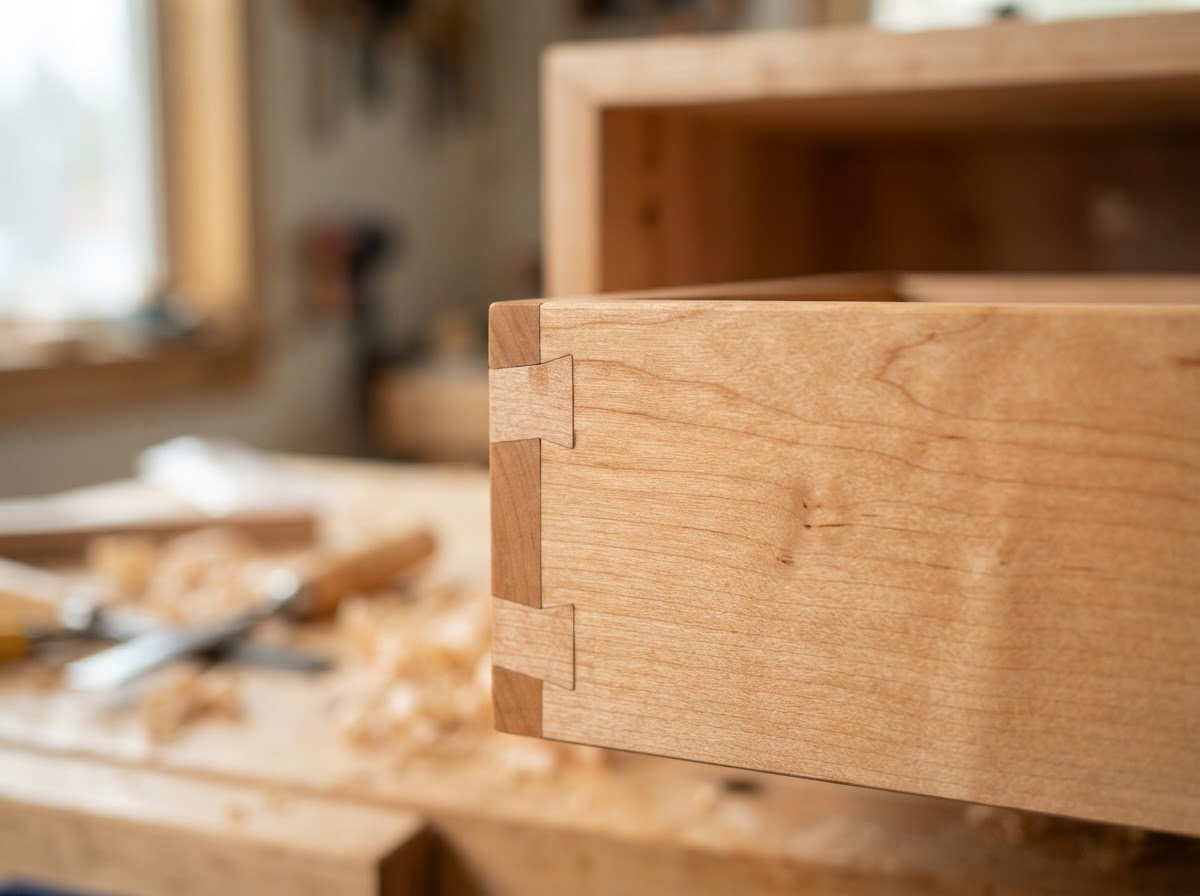
A dovetail is a series of angled pins and tails cut into the ends of two boards so they interlock — the wedge shape pulls the joint tight every time the drawer is opened. It's a mechanical lock, not just a glued surface. The glue is still there, but the joint doesn't depend on it the way a butt joint or a stapled corner does.
That's the difference: load a dovetail drawer with pots and the force transfers into the interlocked wood, not into a line of glue or a couple of staples working loose. It's the same joinery that's held furniture together for centuries, scaled down to a drawer box.
Dovetail vs. stapled drawers
The cheaper alternative is a butt-jointed, stapled, or doweled drawer box — sides butted against the front and fastened with a few staples or a dowel. It's fast and inexpensive, and for a linen cabinet it's often fine. In a kitchen drawer that gets opened forty times a week and loaded with dishes, the staples work and the joint loosens.
Dovetails cost more because each corner has to be cut, not just stapled — there's machine time and setup behind every drawer. That cost is the reason not every cabinet has them, and the reason they're a reliable marker of how seriously a shop builds.
- Mechanical interlock — the joint tightens under load instead of loosening.
- Holds fasteners and glue together long after a staple-only corner has given up.
- The easiest single detail to check when comparing cabinet quotes.
How to spot one in a showroom
Pull a drawer out and flip it over. A dovetail shows a row of angled 'tails' cut into the side board, mating with matching pins on the front — it looks like interlocking fingers. A stapled box just shows staples at the corners. If the shop won't let you look at a drawer box, that's an answer in itself.
Every drawer we build is dovetailed in solid wood, with full-extension soft-close slides. It's not an upgrade — it's the floor. Pull one of ours and you'll see the difference before you read a word of the spec sheet.